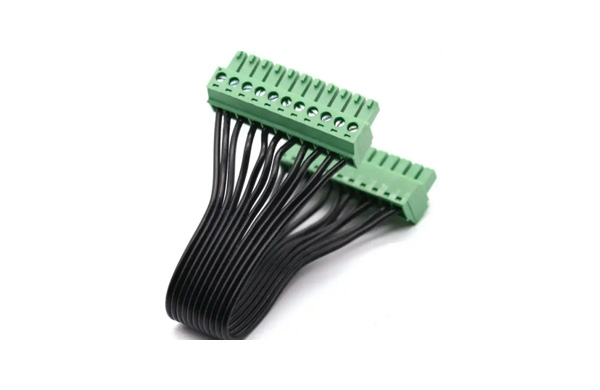



Six Causes of Poor Contact in Terminal Wires and Their Solutions
 Release time:2026-10-13
 Number of views:15


Release time:2026-10-13
Number of views:15
Poor contact in terminal wires is a common fault in electronic devices, which may lead to signal interruption, equipment malfunction, or even safety hazards. Below are six common causes and corresponding solutions:
1. Terminal oxidation or corrosion
Reason: Metal terminals exposed to damp or acidic/alkaline environments develop oxide layers (such as verdigris or aluminum rust), resulting in increased contact resistance.
Solution:
Gently sand the oxide layer with fine sandpaper or metal polish.
Apply conductive grease or an antioxidant (such as vaseline) to prevent recurrence.
Replace with corrosion-resistant terminals such as gold-plated or silver-plated ones.
2. Loose or deformed plug connections
Reason: Excessive insertion and removal of terminals, deformation due to external impact, or fatigue-induced loss of elasticity in the socket's spring blades.
Solution:
Adjust the angle of the socket spring plate with tweezers to restore the clamping force.
Replace the damaged terminal or socket, and choose a connector with a locking structure.
Secure the cables with heat shrink tubing or cable ties to minimize movement.
3. Poor wire soldering
Cause: Poor soldering, cold soldering, or mechanical stress causing the solder joint to break.
Solution:
Resolder the joints to ensure smooth and full soldering, free of bubbles.
Use flux (such as rosin) to improve soldering effectiveness.
Apply adhesive (such as epoxy resin) to fix the solder joints.
4. Pollutants (dust, oil stains)
Cause: Dust and oil stains adhering to the terminal surface hinder conductivity.
Solution:
Wipe the contacts with anhydrous alcohol or electronic cleaner.
Use a dust cover or sealant to protect the connector.
Avoid using the equipment in environments with dust or oil contamination.
5. Excessive current causes ablation
Cause: Overload or short circuit causes terminal overheating, leading to metal melting and carbonization.
Solution:
Replace the burnt terminals and check if the circuit is overloaded.
Select connectors with higher current ratings (such as copper alloy terminals).
Add a fuse or overcurrent protection circuit.
6. Internal cable breakage
Reason: The wire core breaks (intermittent connection) due to frequent bending, aging, or rodent gnawing.
Solution:
Use the continuity test function of a multimeter to detect the break point in sections.
Cut off the damaged section and re-crimp the terminal.
Select high-flexibility cables to avoid bending dead zones.
Preventive Recommendations
Regularly check the terminal connection status, especially in vibration-prone environments (such as automotive equipment).
Priority is given to connectors with an IP67 or higher protection rating (dustproof and waterproof).
Implement redundancy in critical components (e.g., dual-terminal parallel connections).
By conducting targeted inspections and addressing issues, most poor contact problems can be effectively resolved. For complex issues, it is recommended to use professional tools (such as contact resistance testers) for further diagnosis.